
%201.svg)
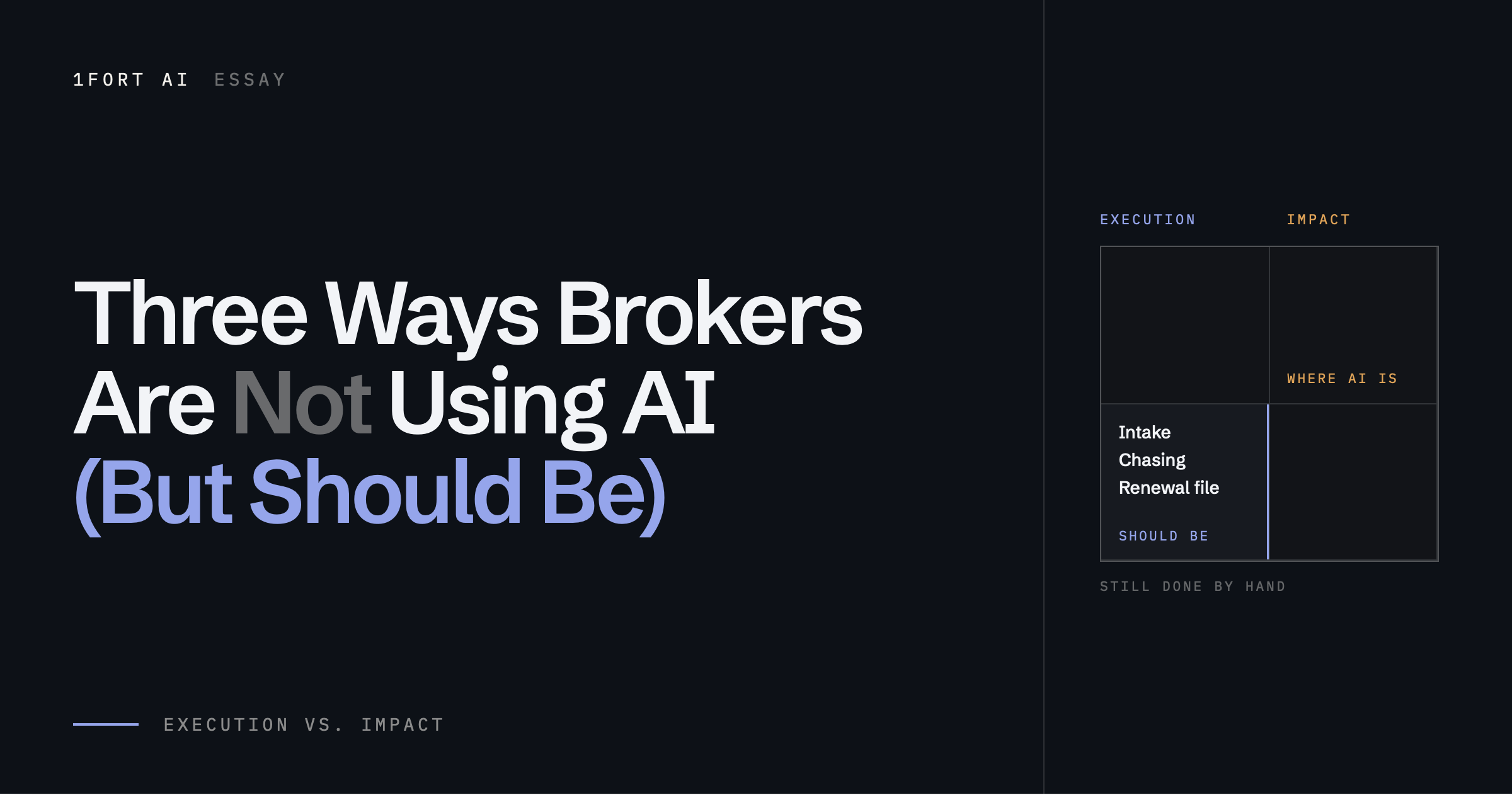
Three Ways Brokers Are Not Using AI
(But Should Be)
Most brokers are using AI right now. They're using it to write emails, polish proposals, draft LinkedIn posts. The parts of the job where a client can actually feel a human on the other end.
Meanwhile the re-keying, the chasing, the file building, the work no client ever sees, still runs on somebody's afternoon.
Every job in a brokerage sits on one side of a line.
On one side, execution: the work has to be done, but the person on the other end can't tell who did it.
On the other side, impact: the person on the other end feels the difference.
AI belongs on the execution side. This is a should argument, and it starts with three jobs sitting on the wrong side.
Submission intake
An account manager receives an application by email. She reads the PDF, keys it into the AMS, keys it again into three carrier portals, attaches loss runs, sends it off.
Four systems touched. Zero people impacted.
The underwriter who opens that submission cannot tell whether a human or a machine keyed it. The client will never know it happened at all.
This is the purest execution work in the agency, and in most agencies it is still done by hand, by the people hired for their judgment.
Chasing the market
Once submissions go out, someone has to know where they stand. Who quoted. Who declined. Who went quiet. Which underwriter needs a nudge and which one needs a supplemental.
Brokers treat this as relationship work because it happens over email with people they know. Look closer. The relationship moment is the call where you put options in front of the client. Everything upstream of that call, the tracking, the nudging, the status file, is execution wearing a relationship costume.
Hand the tracking to a machine and the broker walks into the client call earlier, with more markets quoted.
The renewal file
Every renewal strategy conversation depends on a file: expiring terms, loss history, exposure changes, everything the client mentioned across twelve months of email.
Building that file is archaeology. So it starts late.
And when the prep starts late, the strategy starts late, and a renewal that should have been remarketed gets rolled over at whatever the incumbent offered.
The conversation is the impact. The file is execution. Separate the two and renewals start at 120 days out instead of 45, and the client feels it in the one place that matters, the options on the table.
Where the line is
The line between execution and impact is not fixed. It moves every quarter, and it only moves one direction.
An underwriter opening a submission can't tell who keyed it. A client on a renewal call can tell in thirty seconds who built a strategy and who is reading the file for the first time.
Same technology. Two brokers looking at it.
One sees a writing assistant.
One sees the afternoon back.


